Temporary Email vs. Email Aliases: Which One Is Better?
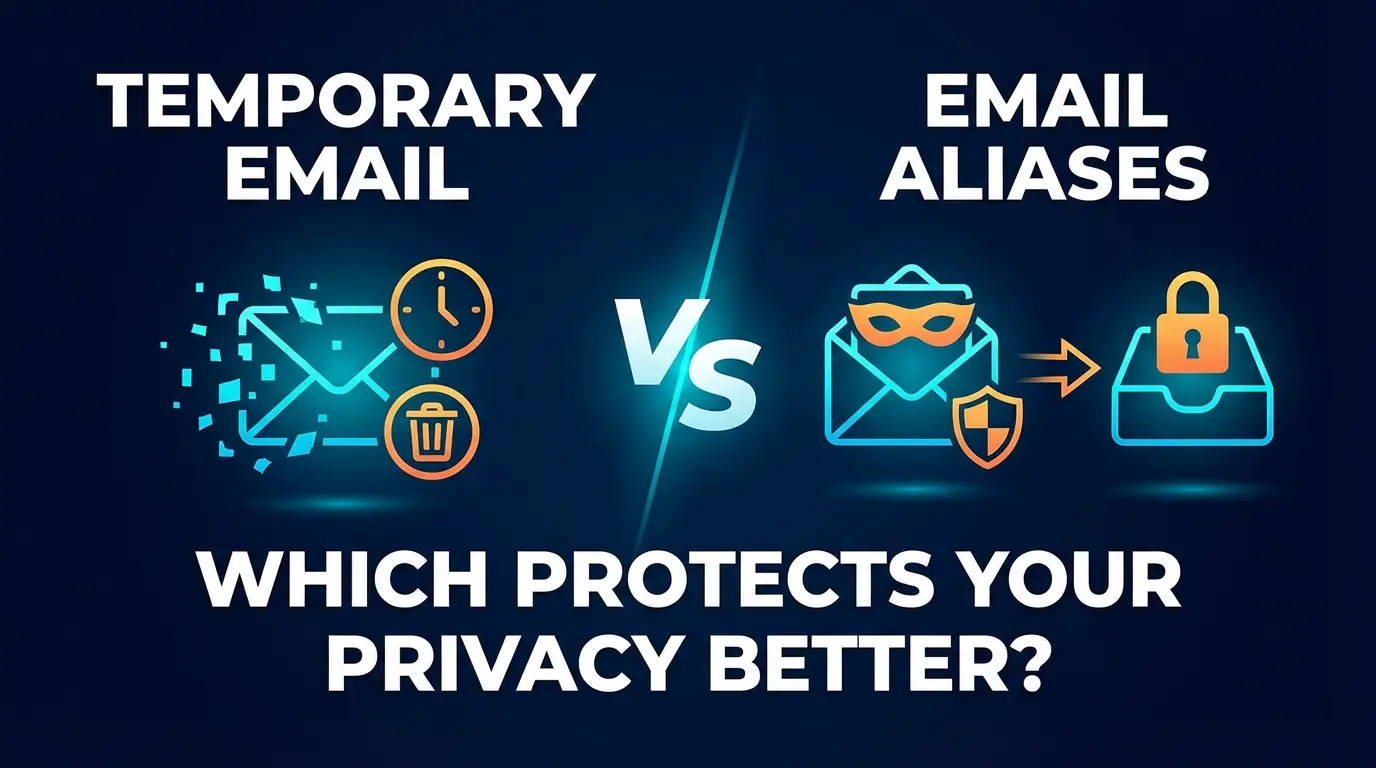
If you are tired of spam, phishing attempts, and non-stop promotional newsletters, you have likely looked for a solution and found the two main contenders: Temporary Emails (like Temp Free Mail) and Email Aliases (like Apple's Hide My Email or SimpleLogin).
At first glance, they seem to do the exact same thing: they hide your real email address from the public. But under the hood, they function very differently. Choosing the wrong tool for the wrong situation can either leave you frustrated with too much maintenance or, worse, leave your personal data exposed. In this guide, we break down the fundamental differences to help you decide which tool belongs in your privacy toolkit in 2026.
Need Zero-Maintenance Temp Mail?
Use our Free Disposable Email Generator to get instant OTPs without registration.
What is an Email Alias?
Think of an email alias as a "forwarding address" for your digital post. You give out a fake address (the alias) to a website, and any mail sent to that alias gets automatically forwarded to your real, primary inbox. If that specific alias starts getting spammed, you can simply "burn" (delete or pause) it from your alias dashboard.
Common Examples: Apple iCloud Hide My Email, Firefox Relay, SimpleLogin, and Addy.io.
The Myth of "Plus Addressing"
Many people think adding a + sign to their Gmail (e.g., john+newsletter@gmail.com) counts as an alias. It does not. Spammers, marketers, and hackers simply use a basic script to strip the +newsletter part to find and target your real email address. True aliases completely mask your identity.
The Pros of Aliases:
- Permanence: You can keep an alias active for years. This makes them great for services you actually use regularly, like Netflix, Amazon, or your bank.
- Reply Capability: Most premium alias services allow you to reply to emails via a reverse-proxy, keeping your true address hidden even in two-way conversations.
- Organization: You can create custom labels and filters in your main inbox based on which alias received the email.
What is a Temporary Email?
A Temporary Email (often called disposable or burner email) is like a "burner phone." It is a completely standalone mailbox that exists for a short, finite amount of timeâ€â€from 10 minutes to a few hoursâ€â€and has absolutely zero connection to your real identity. There is no forwarding. There are no accounts. Just a volatile, temporary inbox.
Common Examples: Temp Free Mail, 10MinuteMail, GuerillaMail.
The Pros of Temp Mail:
- True Anonymity: Since there is no forwarding mechanism, there is absolutely no link between the temp mail and your real email. Even if the temp mail provider is compromised, your real email remains completely unknown.
- Speed & Convenience: No account setup, passwords, or configuration required. You just visit the site, copy the email string, and go.
- Zero Maintenance: You do not have to "manage," "pause," or "delete" these emails. The system purges them automatically.
| Feature Comparison | Email Aliases | Temporary Email |
|---|---|---|
| Setup Time | High (Requires Login/Config) | Instant (One Click) |
| Link to Real Identity | Yes (Forwarding Backend) | No (Completely Isolated) |
| Lifespan | Permanent / Long-term | Short-term / Session-based |
| Best Used For | Subscriptions, Main Shopping | One-time downloads, Sketchy sites |
When Should You Use Which?
Use an Email Alias When:
You want to sign up for a service you will use repeatedly, but you don't trust them fully. For example, a flight booking site, a monthly newsletter, or a SaaS subscription. You need to receive receipts, password resets, and updates over time, so you cannot afford to have the email address disappear tomorrow.
Use a Temporary Email When:
You need to perform a "Hit and Run" operation. Using Temp Mail helps you avoid "Alias Fatigue"â€â€the exhaustion of managing and deleting hundreds of forwarding addresses for random websites you don't care about.
- The "Free Ebook" Trap: You want the PDF download, but you know they will spam you forever.
- Untrusted Wi-Fi: You need to sign in to public airport or cafe Wi-Fi.
- QA Testing: You are a developer testing a signup flow.
- Online Forums: You want to view a hidden link on a forum but never intend to return.
The Privacy Gap: Data Breaches
Here is the critical privacy distinction: Data Retention. If you use an alias service, you have an account there. If that service is subpoenaed or breached, your real email address (which the aliases forward to) is on file in their database. With Temp Free Mail, we don't know who you are. We don't have your real email. If a government or hacker demanded our user data, we would have nothing to give them. That is the power of true volatile memory.
Frequently Asked Questions (FAQ)
Are email aliases free to use?
Many alias services offer a limited free tier (e.g., 10 aliases), but you usually have to pay a monthly subscription for unlimited aliases and custom domains. Temp Free Mail is completely free and unlimited.
Can I reply to an email using Temp Free Mail?
Temp Free Mail is designed purely as a "receive-only" sandbox to protect you from spam and tracking. For two-way conversations, an email alias is the better tool.
Which is better for stopping spam?
Both are excellent. Aliases require you to manually toggle the "off" switch when the spam gets too heavy. Temp Mail stops spam automatically because the inbox simply ceases to exist after you close the tab.
Conclusion
Both tools are essential components for a privacy-conscious user in 2026. Use email aliases for accounts you care about and intend to maintain a relationship with. Use Temp Free Mail for absolutely everything else.
By keeping your digital trash completely separate from your digital treasures, you ensure a cleaner, safer, and much more peaceful primary inbox.